SLAC-Stanford team develops a better method to create superlattices with a twist
Imaging at SLAC's synchrotron demonstrates the twisted structures’ exotic properties that could benefit the development of superconductors and quantum materials.
By Emily Ayshford
Key takeaways:
- Stanford Chemistry Professor Fang Liu developed a new method to create moiré superlattices made of stacked 2D materials on much larger scales than possible before.
- These twisted materials have previously shown exotic quantum effects, such as superconductivity.
- SLAC scientists led by Donghui Lu and Makoto Hashimoto used angle resolved photoemission spectroscopy (ARPES) to show evidence of the backfolded band – the energy band where the interesting physics happens.
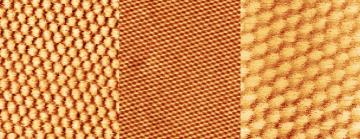
Exciting electronic characteristics emerge when scientists stack 2D materials on top of each other and give the top layer a little twist.
The twist turns a normal material into a patterned lattice and changes the quantum behavior of the material. These twisted materials have shown superconductivity – where a material can conduct electricity without energy loss – as well as special quantum effects. Researchers hope these “twistronics” could become components in future quantum devices.
But creating these extremely thin stacked structures, called moiré superlattices, is difficult to do. Scientists usually peel off single layers of material using Scotch tape and then carefully stick those layers together. However, the method has a very low success rate, often leaves behind contamination between layers and produces tiny samples smaller than the width of a human hair. These samples are extremely hard to reproduce, and it’s nearly impossible to scale them up to real devices, which limits the kinds of experiments researchers can perform to uncover the strange quantum behaviors inside.
Now, Stanford University Chemistry Professor Fang Liu has developed a new way to create these lattices that is cleaner and scalable to millimeters and centimeters in size with nearly perfect yield. To show the potential properties of her materials, Liu worked with researchers at the Department of Energy’s SLAC National Accelerator Laboratory. The team published their results in the Journal of the American Chemical Society.
Stanford Synchrotron Radiation Lightsource
SSRL's extremely bright X-rays are a resource for researchers to study our world at the atomic and molecular level, leading to major advances in energy production, environmental remediation, nanotechnology, new materials, biology and medicine.

Using powerful X-rays from the lab’s Stanford Synchrotron Radiation Lightsource (SSRL), SLAC researchers imaged the electronic structure of the superlattices. With a technique called angle-resolved photoemission spectroscopy (ARPES), they observed a distinct electronic “fingerprint” of how electrons are arranged inside the new superlattices that confirmed the unique behavior of moiré materials.
“No one has been able to resolve these fingerprints at the band edge of a twisted semiconductor at this resolution before,” Liu said. “For the first time, we can fully see the effect of these phenomena.”
Creating clean superlattices
The power of these structures lies in their architecture. When the layers are stacked at a slight angle, their twisted pattern reshapes the electronic landscape. Instead of moving freely, the material’s electrons become trapped, tunnel between layers, line up in repeating patterns and even form intricate electron superlattices. This unusual choreography gives rise to a host of exotic quantum phenomena.
But the Scotch-tape method to create them is “extremely low yield, inefficient and depends on luck,” Liu said.
Liu’s graduate student Gregory Zaborski Jr. and the team came up with a new way of building these structures using gold as a kind of super sticky tape. The gold clings more strongly to a 2D material’s atomic layers than the weak forces that hold them together, allowing researchers to peel off a single sheet. By carefully stacking two of these freshly peeled layers with just the right twist, the team can create ultraclean moiré structures that are high in quality and large enough to see with the naked eye.
“It peels off very easily, with a yield approaching 100%,” Liu said. The samples are also large: While they are only one to a few atoms thick, they can be as wide as a few centimeters, which is important for building actual devices with them.
Liu and her team used the method to create moiré superlattices from several 2D materials, including graphene, molybdenum disulfide and other semiconductor and insulator materials that scientists are interested in for nanoelectronics, sensors and energy storage.
Imaging the backfolded band
To test that the new superlattices had unique electronic properties, Liu turned to SLAC. There, the team used ARPES to probe the electronic structure of the moiré superlattices. The technique directs SSRL’s X-rays at the sample, which in turn emits photoelectrons that carry critical information about the electrons inside the material, such as the energy-momentum relationship of those electrons, or band structure. Researchers use that information to understand how a material’s electronic states create certain exotic behaviors, including quantum phenomena.
Stanford: Light causes atomic layers to do the twist
Researchers have not been able to fully understand moiré superlattices in previous experiments because sample sizes had been too small and not uniform enough. But with Liu’s larger and cleaner samples, Lu and the team succeeded with imaging the superlattice in high enough resolution to identify what is known as a “backfolded band” – an energy band that plays a role in intriguing physics phenomena, like superconductivity.
“It was a perfect match between our beam characteristics and the sample quality,” Lu said. “Combining the large-area, high-quality sample with the high-throughput measurement at SSRL, we were able to achieve a resolution that highlighted the true breakthrough of Fang’s work.”
Next, Liu plans to make a device with the superlattices to test their ability to achieve interesting physical phenomena.
“And we will be ready to image those with ARPES,” Lu said.
Large parts of this research were supported by DOE’s Office of Science and the Defense Advanced Research Projects Agency (DARPA). SSRL is a DOE Office of Science user facility.
Citation: G. Zaborski et al., Journal of the American Chemical Society, 8 October 2025 (10.1021/jacs.5c09131)
For media inquiries, please contact media@slac.stanford.edu. For other questions or comments, contact SLAC Strategic Communications & External Affairs at communications@slac.stanford.edu.
About SLAC
SLAC National Accelerator Laboratory explores how the universe works at the biggest, smallest and fastest scales and invents powerful tools used by researchers around the globe. As world leaders in ultrafast science and bold explorers of the physics of the universe, we forge new ground in understanding our origins and building a healthier and more sustainable future. Our discovery and innovation help develop new materials and chemical processes and open unprecedented views of the cosmos and life’s most delicate machinery. Building on more than 60 years of visionary research, we help shape the future by advancing areas such as quantum technology, scientific computing and the development of next-generation accelerators.
SLAC is operated by Stanford University for the U.S. Department of Energy’s Office of Science. The Office of Science is the single largest supporter of basic research in the physical sciences in the United States and is working to address some of the most pressing challenges of our time.
Related stories


Jennifer Cochran is the new Stanford vice president for SLAC and for strategic initiatives